
Les diabétiques ont un risque accru de maladies oculaires telles que la rétinopathie diabétique, le glaucome ou les cataractes. Des examens oculaires réguliers et spécialement chronométrés sont cruciaux pour détecter les complications tôt et protéger votre vision.
Le diabète sucré pose un défi particulier pour la santé oculaire, car des niveaux de sucre dans le sang constamment élevés peuvent endommager les vaisseaux sanguins de la rétine. En plus de la rétinopathie diabétique, d'autres maladies telles que le glaucome et les cataractes sont également plus fréquentes chez les diabétiques. C'est pourquoi un examen oculaire régulier est essentiel pour minimiser le risque de perte de vision.
Cette maladie rétinienne, causée par le diabète, est due à des dommages aux petits vaisseaux sanguins de la rétine. Aux premiers stades, la maladie reste souvent asymptomatique, ce qui rend les examens réguliers d'autant plus importants. Cependant, si elle n'est pas traitée, elle peut entraîner une perte de vision, accompagnée de symptômes tels que vision floue, points flottants ou perte de vision soudaine.
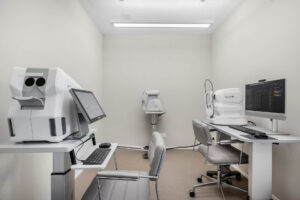
Notre cabinet propose des examens complets spécifiquement adaptés aux besoins des diabétiques. Ceux-ci incluent :
La fréquence des examens dépend du contrôle de votre taux de sucre dans le sang et de l'évolution de votre diabète. Les recommandations générales sont :
Des examens réguliers aident à détecter les complications à un stade précoce et à protéger votre vision à long terme. Prenez rendez-vous aujourd'hui pour assurer la santé de vos yeux.
Pourquoi les diabétiques ont-ils un risque accru de maladies oculaires ?
Des niveaux de sucre dans le sang élevés endommagent les vaisseaux sanguins de la rétine et augmentent le risque de maladies telles que la rétinopathie diabétique, le glaucome et les cataractes.
Qu'est-ce que la rétinopathie diabétique ?
Une maladie de la rétine causée par des dommages aux petits vaisseaux sanguins. Elle reste souvent asymptomatique pendant longtemps et peut entraîner une perte de vision si elle n'est pas traitée.
En tant que diabétique, à quelle fréquence devrais-je faire examiner mes yeux ?
Au moins une fois par an, même s'il n'y a pas de symptômes. En cas de niveaux de sucre dans le sang instables ou de problèmes de vision, des contrôles plus fréquents sont utiles.
Les examens sont-ils douloureux ?
Non, tous les tests, tels que l'examen du fond d'œil ou la mesure de la pression intraoculaire, sont indolores et sans complications.
Chères patientes et chers patients,
notre cabinet sera fermé du 28.07.2025 au 03.08.2025 inclus fermé.
À partir du 04.08.2025 nous serons de nouveau à votre disposition comme d'habitude.
En cas d'urgence, veuillez contacter le service d'urgence médicale au numéro de téléphone :
0800 33 66 55
Vous pouvez prendre rendez-vous à tout moment en ligne ou via notre site web.
Nous vous remercions de votre compréhension !
Votre équipe de cabinet