Cataract (Katarakt): causes, symptoms, surgery, and modern lenses in one article
In the grandfather's car on an autumn afternoon, he has already postponed changing his glasses several times, and now the sun is so dazzling that he can hardly see the road. When reading at home, the letters gradually blur, even though he got new glasses three months ago. The family doctor looks at him and says: Cataract.
This is the most common eye diagnosis from age 60, and many patients hear it for the first time in a situation just like this, when they already see it themselves: something is wrong with my vision, I have just attributed it to something else until now.
The Cataract (Katarakt, medically Cataracta senilis) is the gradual clouding of the eye lens. It is not a disease in the strict sense, but an age-related process. Just as hair turns gray and skin loses elasticity, the protein structure of the eye lens also changes over the years. According to WHO, cataract is the leading cause of preventable blindness worldwide.
The good news consists of two parts. First: modern cataract surgery is one of the safest and most effective procedures in medicine. Outpatient, painless, about 15 to 20 minutes per eye. Second: with modern intraocular lenses (IOL), not only can vision improvement be achieved, but dependence on glasses can also be significantly reduced, in many cases completely eliminated.
In this article
What happens in the eye lens
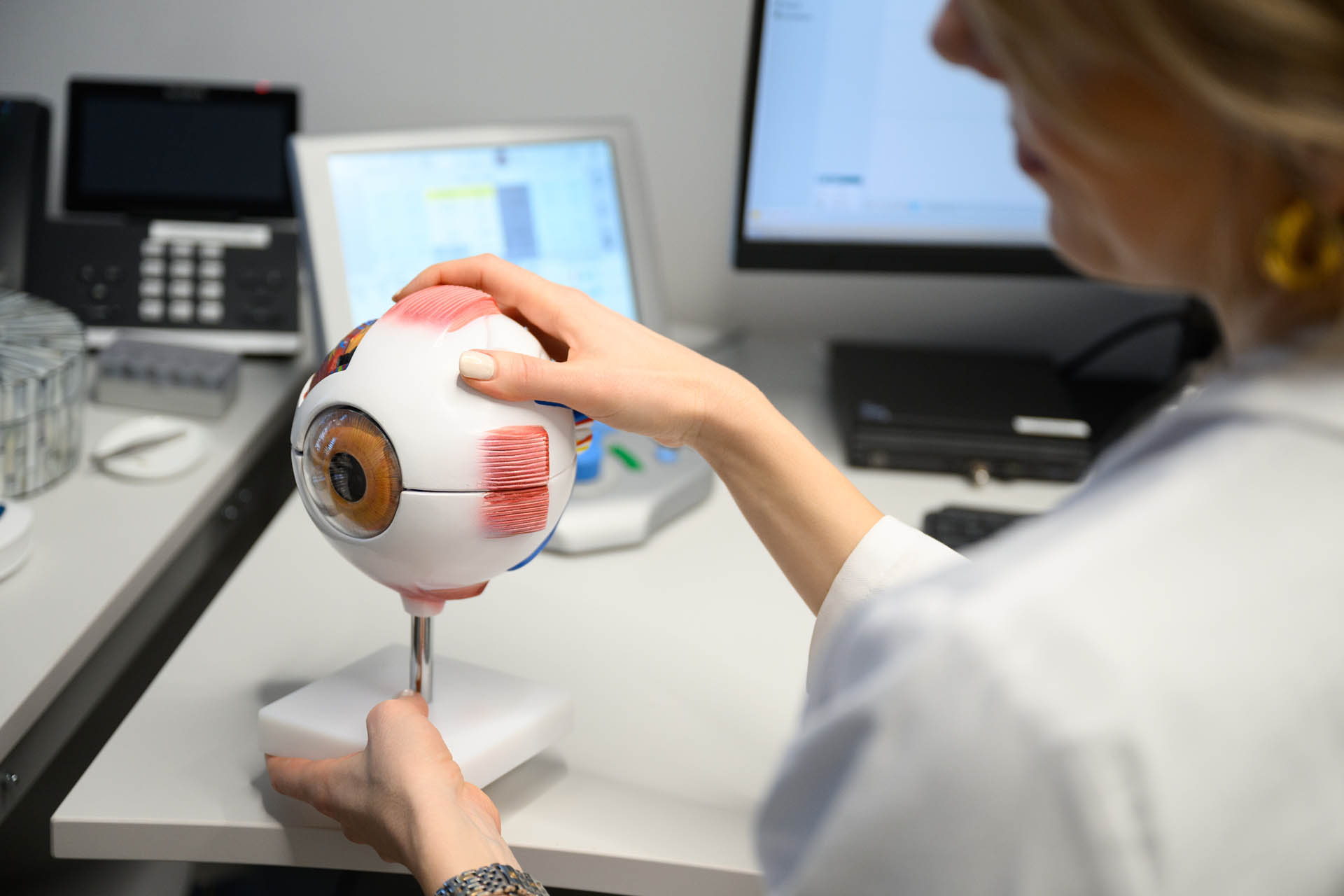
The eye lens is a transparent, elastic structure behind the pupil. Its task is to focus light on the retina and to adapt to different viewing distances (accommodation). The lens is mainly composed of proteins and water, with the strictly ordered arrangement of proteins creating transparency.
Over the years, the lens proteins denature: they stick together, form clumps, and lose their original spatial arrangement. The process is very slow, stretching over decades. The lens initially turns yellow in the core, then in the cortex, later it becomes milky cloudy. Light can no longer penetrate as sharply as before, and a scattered, unclear image reaches the retina. The patient experiences this as gradually blurred vision.
This aging process begins in everyone, just at different speeds. For some, it leads to significant discomfort as early as 55 to 60 years, while for others, surgery is not necessary even at 75. The individual variability is large.
The causes in detail
The most common cause of cataracts is age. Age.. In addition to age, several risk factors play a role.
UV radiation is a direct risk factor. Wearing sunglasses is not just an aesthetic choice, but an ophthalmological preventive measure, especially in environments with high UV intensity (mountain sun, beach, skiing). Long-term UV exposure damages lens proteins more quickly.
Diabetes is a significant risk factor. In diabetics, cataracts occur on average three to five years earlier, and the progression is often faster. The elevated blood sugar level chemically reacts with lens proteins.
Smoking significantly increases the risk of cataracts, especially nuclear cataracts. Cigarette smoke causes oxidative stress in the lens.
Long-term corticosteroid treatment (corticosteroids over weeks or months, whether as drops or tablets) is the classic cause of posterior subcapsular cataracts. This type is almost specifically induced by steroid therapy.
Eye trauma can lead to cataracts immediately or even years later. A significant blunt impact in the eye area or a penetrating injury can impair the microstructure of the lens.
Also, genetic factors play a role. There are families in which cataracts occur before the age of 50. Congenital cataracts (cataracta congenita) can be present in newborns and require prompt ophthalmological intervention for normal visual development.
Certain metabolic disorders (galactosemia, Wilson's disease), autoimmune uveitis, and previous eye surgeries (especially vitrectomies) also increase the risk.
The three main types of cataract
The ophthalmologist distinguishes three main types depending on the location of the opacification. These can partially overlap, and multiple types can be present in one eye simultaneously.
Three main types
Type 1
Nuclear cataract
The most common age-related type. The lens nucleus yellows, gradual deterioration of vision, often with a temporary „second spring.“.
Type 2
Cortical cataract
Radial pattern from outside to inside. Characteristic: glare from car headlights at night.
Type 3
Posterior subcapsular cataract
Younger onset, often after steroids or in diabetes. Rapid deterioration of near vision.
In practice, a mixed form is usually present, where multiple types are simultaneously present.
Symptoms that you must perceive yourself
The symptoms of cataracts usually develop gradually. Many patients think that their glasses prescription has changed and have new glasses made several times before it becomes clear that the problem lies in the lens.
Gradually blurred vision. Not a sharp, sudden blurriness, but the eye increasingly looks through a fog. At first, perhaps just a bit more strenuous when reading, later the images also become grayer, less contrasting.
Glare and halo phenomena. A halo appears around lights, especially at night. Driving in front of car headlights becomes difficult and disturbing. The sun is painfully bright in the eye.
Color fading. The colors gradually become dull, as if a yellowish filter is over the eye. The patient often does not notice this themselves, as they slowly adapt. After the operation, the colors suddenly return, and the patient says: „I didn't even realize that I hadn't seen a blue sky properly for years.“.
Double vision in one eye (monocular diplopia). When looking with one eye, the image is seen „double.“ The clouding of the lens causes multiple light refraction.
Changing glasses needs. Within a few months, the patient needs new glasses several times, and none is „the right one.“ A classic sign: the lens refractive power changes continuously.
Night blindness. The pupil is larger in the dark, allowing more light to enter through the peripheral lens areas affected by cataracts. Driving at night becomes increasingly difficult.
Rapid blurring of central vision. Especially with the posterior subcapsular type. When reading, the text „swims,“ even worse in bright surroundings.
The „second spring.“. Temporarily, with nuclear cataracts, the lens refractive power can increase so much that a previously farsighted eye sees better up close again. This condition is temporary, then vision deteriorates further.
If several of these symptoms are persistently present, an eye examination is advisable. The diagnosis is simple; the slit lamp examination and visual acuity test clearly show cataracts and their severity in most cases.
When is surgery advisable?
This is one of the most common questions in ophthalmology: „But when do I need to have surgery?“ The short answer: when the quality of vision already affects daily life. The longer answer is a bit more nuanced.
There is no absolute visual acuity threshold below which surgery is „necessary.“ A 90-year-old retiree who reads and watches TV for three hours daily reports a problem at a different visual acuity than a 65-year-old gardener or taxi driver. The indication for surgery is determined by the ophthalmologist together with the patient, considering daily life, professional requirements, and hobbies.
Classic indications are: driving becomes difficult, reading and fine tasks become strenuous, work becomes difficult (drivers, pilots, precision workers), colors and details are disturbingly muted, balance and everyday safety are endangered in older patients due to reduced contrast sensitivity. Also, asymmetric cataracts, when one eye is significantly worse than the other, are an indication for surgery.
The second common question: „But isn't it too early?“ In modern cataract surgery, the answer is no. Early surgery is safer (the lens is still easier to remove), healing is faster, and quality of life improves sooner. A 65-year-old patient who has surgery now enjoys better vision for 20 to 25 years instead of waiting until 78.
Adlerblick Eye Medicine · Döttingen
Clarity before the decision
A careful diagnosis and a consultation in which we discuss together the suitable lens and the right timing.
The operation step by step
The modern cataract procedure is called Phacoemulsification. Outpatient, under local anesthesia, and the patient can go home after a short recovery.
Preparation takes place in the days before the surgery. The ophthalmologist conducts a detailed eye examination, measures the eye parameters with a laser biometric device (IOL Master), and together with the patient, the optimal type of intraocular lens is discussed. In the days before the surgery, the patient starts with antibiotic eye drops.
On the day of the surgery, the eye is numbed with drops. The patient is conscious but pain-free. The position on the operating table is comfortable and flat on the back.
The course of the surgery
- The surgeon makes a 2 to 3 mm small incision at the edge of the cornea. Through this access, the lens is reached.
- The lens capsule is opened through a circular opening.
- The cloudy lens substance is broken down into small pieces and suctioned out using an ultrasound probe (phaco).
- The doctor inserts the intraocular lens (IOL) into the empty lens capsule. The lens is folded and introduced through the small incision, unfolding in the eye.
- The incision is not stitched because the cornea closes self-sealing. The entire procedure takes 15 to 20 minutes per eye.
After the surgery, the doctor starts with antibiotic and anti-inflammatory drops, and the patient can go home after a short recovery. Usually, two to four weeks are waited before the surgery of the second eye.
The selection of the intraocular lens: standard, toric, multifocal, EDoF, trifocal
The intraocular lens (IOL) is a small lens made of acrylic or silicone that remains in the eye for a lifetime. Choosing the right type is as important for the surgical outcome as the surgery itself.
The Standard monofocal lens provides sharp vision at a single distance. Usually, it focuses on distance vision, and for reading and near tasks, the patient uses glasses. This is the oldest type and still the most common choice today. The Swiss basic insurance covers this.
The Toric lens corrects the lens shape in the presence of astigmatism (corneal curvature). Those with astigmatism can significantly reduce their dependence on glasses with a toric lens.
The Multifocal lens is simultaneously focused on multiple distances. Modern multifocal lenses use a diffraction pattern to direct light to multiple focal points. The patient sees well both near and far, often without glasses. A slight halo phenomenon may occur, especially at night.
The EDoF lens (Extended Depth of Focus) offers a continuous, extended focus range that covers intermediate and far distances. A slight reading glasses may be needed for near vision. The halo phenomenon is less than with classic multifocal lenses.
The trifocal lens is the most modern solution: near, intermediate, and far focus simultaneously. In well-selected candidates, dependence on glasses can be almost completely eliminated.
The right lens choice is not only about technology but also about the patient's daily life. For a car-driving patient, the halo phenomenon is a sensitive point. For a reading-oriented patient, near focus is particularly important. For an astigmatic patient, the toric component is indispensable. This individual decision is made by the specialist doctor and the patient in a joint consultation.
The Swiss basic insurance covers the standard monofocal lens. For premium lenses (toric, multifocal, EDoF, trifocal), the patient bears the additional costs. The additional amount varies by lens type and is about 1500 to 4000 CHF per eye, which is worth it for many patients for decades of freedom from glasses.

After the operation: healing and everyday life
The time after cataract surgery usually proceeds very calmly and without problems. Most patients notice a significant improvement in vision the next day, some drive the next day, read, and watch TV.
In the first one to two weeks, the multiple daily application of antibiotic and anti-inflammatory drops according to the schedule provided by the ophthalmologist is mandatory. The drops prevent infections and reduce postoperative inflammation.
In the first weeks, heavy lifting, bending, rubbing the eye, swimming pool, and beach should be avoided. The eye should not be rubbed. Sports that do not strain the eye are possible again after a few days.
Vision gradually clears up, the final result is achieved after about one to two weeks. In some cases, such as with multifocal lenses, cortical adaptation takes four to eight weeks as the brain „learns“ the new image.
The success of the operation is high, complications are rare. The most common complications are a short temporary inflammation, a temporary increase in intraocular pressure, and rarely an infection (endophthalmitis, which requires rapid intervention). The risk of retinal detachment slightly increases after surgery but remains a rare event.
The operation of the second eye typically takes place two to four weeks after the first. This allows for the assessment of the first result and any fine-tuning of the second lens calculation.
What happens: during the operation, the posterior lens capsule is preserved, into which the doctor places the artificial lens. Over time, epithelial cells can grow on this posterior capsule, which clouds vision again. The patient experiences it as if „the cataract is coming back.“ Many are disappointed because they thought the issue was resolved once and for all. It is not entirely, but the solution is extraordinarily simple.
The ophthalmologist opens the posterior capsule with a precise laser through the slit lamp. The procedure is painless, takes a few minutes, and vision returns immediately. The outpatient YAG laser treatments of Adlerblick Ophthalmology are available directly in the practice on the same day.
Frequently asked questions
Question
At what age does cataract typically occur?
Most commonly after the age of 60. In more than half of those over 65, a partial lens clouding can be detected. In certain cases (diabetes, steroid treatment, trauma, genetic factors), it can occur earlier.
Question
What is the first sign that I notice?
For many patients, glare and the halo phenomenon at night are the first signs. For others, it is the fading of colors, difficulty reading, the frequently changing need for glasses. If changing glasses no longer resolves the vision problem, an eye examination is indicated.
Question
Do you have to wait until the cataract is „ripe“?
No. That is an old, now outdated notion. Modern cataract surgery is safe at any stage. The timing of the surgery is based on the impairment of quality of life, not on „ripeness.“.
Question
Does the surgery hurt?
No. The surgery is performed under local anesthesia with eye drops, the patient is awake but pain-free. A slight feeling of pressure may occur.
Question
How long does the surgery take?
For each eye, the actual procedure takes 15 to 20 minutes. The entire treatment (including preparation and a short follow-up) takes about 2 hours in the clinic.
Question
When can I return to work?
It depends on the profession. For office work, usually 2 to 3 days are sufficient. For physical work, 1 to 2 weeks are recommended. The ophthalmologist will provide an individual recommendation during the follow-up.
Question
How much time is there between the two eyes?
Typically 2 to 4 weeks. This allows for the assessment of the first result and fine-tuning of the second lens, if necessary.
Question
Which lens should I choose?
That is a decision you make together with the ophthalmologist, based on your daily life, your profession, your hobbies, and the eye parameters. There is no universally „best“ lens.
Question
Can the cataract return?
In the operated eye, no, because the lens has been removed. The posterior lens capsule can become cloudy (after-cataract), which can be resolved in a few minutes with the YAG laser.
Question
Can I lose my vision due to the surgery?
The complication rate of modern cataract surgery is very low, about 1 to 2 percent. Severe complications leading to vision loss occur in less than 0.1 percent of procedures. The surgical risk is significantly lower than the risk of accidents (falls, car accidents) caused by untreated cataracts.
What matters
The cataract is not a disease but a natural age-related process. It cannot be prevented but can be completely treated. Modern cataract surgery has reached a point where many patients experience visual clarity the day after surgery that they have not had for years.
If you notice in recent months that your vision is gradually becoming blurry, that the glasses are repeatedly „not the right ones,“ that halos appear around lights at night, that colors seem duller: an eye examination is the right next step. The diagnosis is simple, the decision is not urgent, but also not to be unnecessarily postponed.
„After the surgery, most patients say: why did I wait so long?“
The Eagle Eye Ophthalmology in Döttingen offers complete cataract-related care: from diagnosis to modern IOL selection to follow-up. The YAG laser capsulotomy for later secondary cataract is directly available in the practice. For the surgical phase, we collaborate with the appropriate cataract centers in the region as needed, so you remain in a continuous care chain.
A timely cataract operation is one of the procedures that noticeably increases quality of life by 10 to 20 years. If you have questions or would like to present a symptom, schedule an appointment online or call the practice. The ophthalmological examination is simple, painless, and the complete picture of your current vision state is available within an hour.